Timeline, Growth and Rigor with the ItsMe Summer Mentorship Program with Children's Book Illustration in Publishing
This post is in continuation of my previous post about joining the ItsMe Summer program.
After formally joining the program and preparing file organization, with my mentor, I decided to focus on children’s book illustration for my portfolio, everything became more structured.
That clarity from the beginning carried directly into how the program was run.
I met my mentor, Min (Minhae Kim), around July 26. With her background working across Seoul and Singapore in both agency and publishing spaces, the way she approached the process felt very grounded in real industry expectations. She was kind, patient, professional, flexible, and understanding throughout the mentorship. She also had experience with licensing, so it was great to share my interest in that with her as well.
From early August to mid-September, everything followed a clear timeline once :
Aug 4: pencil roughs and character studies
Aug 7: feedback
Aug 11: final character studies
Aug 13: approval
Aug 18: first color drafts
Aug 20: feedback
Sept 11: final artwork
The timeline shared with me how quickly some projects may work in the true publishing industry. It can be fast paced at times especially if the client has a a deadline that is not so flexible; of course, I learned that agents will negotiate flexibility with timelines too.
It was a short window. I honestly felt rushed, but that is not due to the program, but rather the fact that I worked a 8AM-5PM job, and I am also a mother on top of that. If I had more time to focus as an artist, I feel like, at least for me, the time with manageable. To accomplish the deadlines with my responsibilities, I had often stayed up until midnight to work.
For the approvals, each stage built on the one before it. I couldn’t move forward until something was actually resolved or tweaked, which made me slow down in a way I hadn’t before. Typically, I work with repeat clients (for commissions or projects), and with clients that want to see "what I come up with" for a final product, so there's typically more creative freedom; of course, for this mentorship, as it replicates what happens in the publishing industry, I have more constraints, and I am working with direction provided to me. There are also many things I had to consider.
Instead of jumping ahead, I had to sit with questions like:
does this pose feel natural or just placed
is the emotion clear without explanation
does this composition support the story
is it necessary to fill a scene with stuff to make it feel like an authentic classroom or is it visual clutter
And because this wasn’t just one illustration, I had to apply that thinking across a full set of images.
That’s where things started to shift for me. It stopped feeling like I was creating individual pieces, and more like I was working through a complete project from beginning to end. And naturally, once you start working that way, the feedback you receive also changes.
It becomes less about surface-level adjustments, and more about how everything works together.
In my illustrations, you can see some things appear like interactions between characters or and a cat that appears across pages to crate a storyline. For example, I imagine there being a cat outside, and a student spotting it, taking a photo of it, and it appearing in the classroom. I also imagined a group of boys listening to their friend about how he lost his tooth. I learned about stories within stories from various videos on the web regarding kidlit art, and I wanted to bring that into my art work. I would like to add: in the cafeteria scene, there is a girl behind Mina (the main character in green) with red hair; Ed Burns found her quite amusing, and he really enjoyed having her in the background.
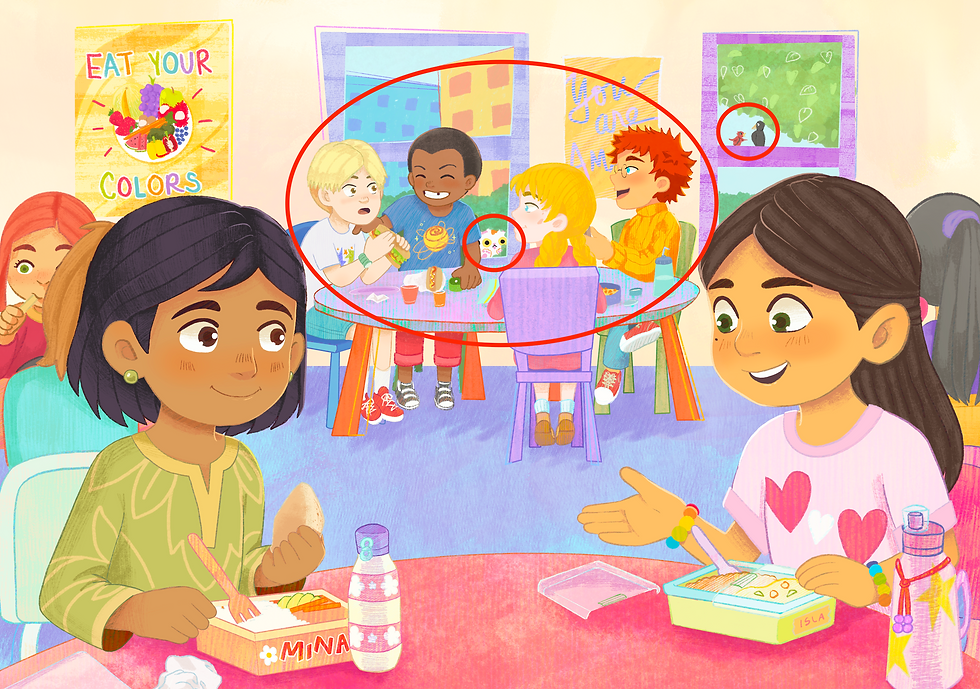

I shared with Min, the most difficult part of all of this is since I am working on the go (when I am watching my child in different rooms of the house or out of the house) or waiting for a dinner reservation with friends, and more, I was limited to working on the iPad, and I did not have ClipStudio fully set up on my iPad during this program, nor was I fully comfortable with Affinity Designer at the time. This meant, with Procreate, I was much more limited on my layer count, and changing scenes (even expressions) meant a bit of a headache with working within layer limits. If anyone is deciding to join a mentorship program or not, one piece of advice I'd give is consider the best programs for your layer limitations and your work flow. Overall, after working tirelessly, I finalized the images which will be shared in the next post regarding the ItsMe Summer Mentorship program. What are some tips you'd like to share from your own research regarding art styles for children's style illustrations?

Comments